From the ICU to “I Do”
How an unexpected stroke united this military couple
5 minutes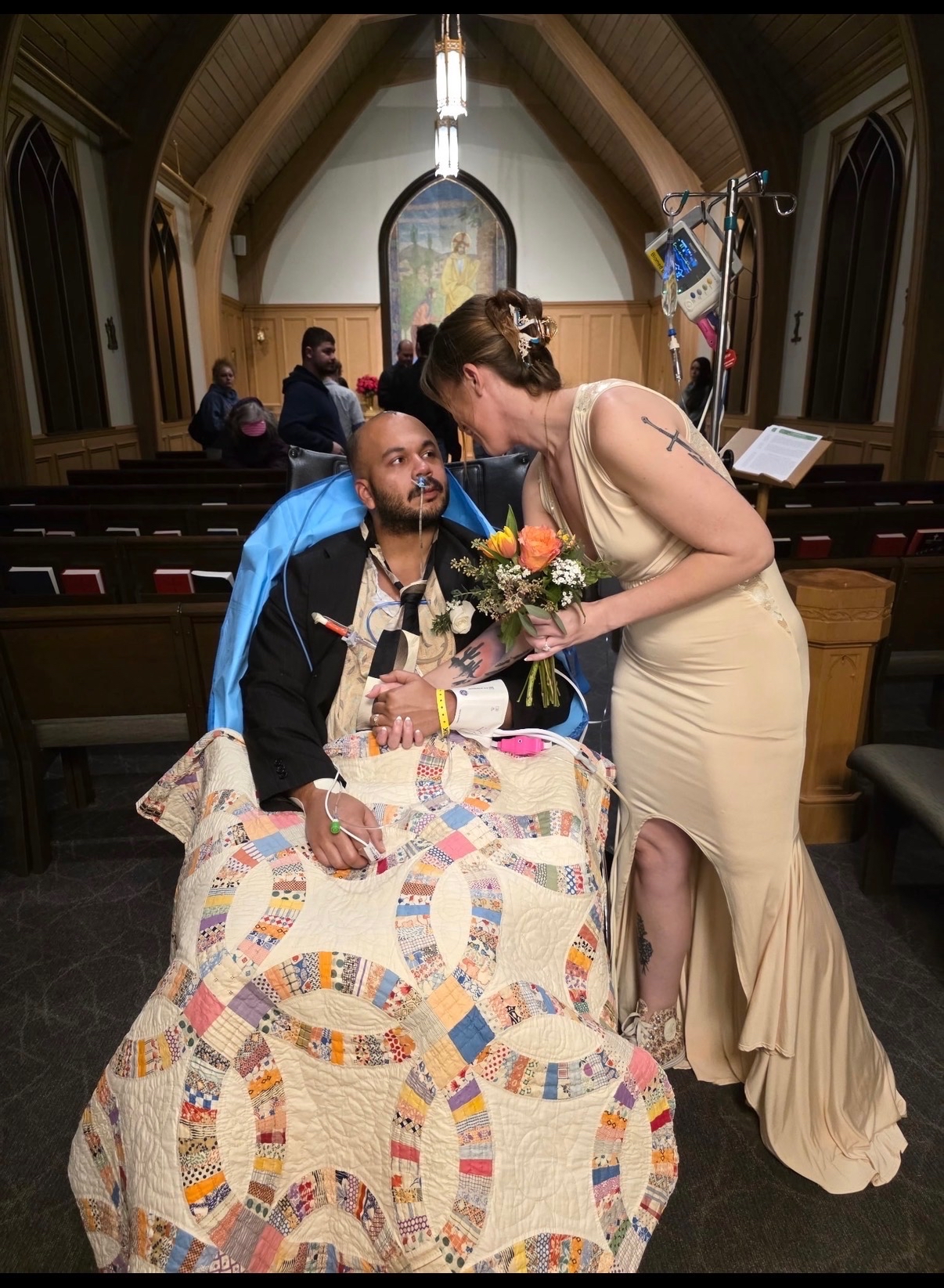 It was their wedding week. They just didn’t know it yet.
In January, Justin Mays, 30, was in the intensive care unit (ICU) at Saint Luke’s Hospital of Kansas City, in severe pain after having a stroke. He had a blood clot and active bleeding in his brain.
His multidisciplinary stroke team had to balance the complexity of a blood clot coinciding with a brain bleed: Blood thinners usually used to treat a blood clot would make the bleeding more severe.
While Justin’s surgical team, led by Carlos A. Bagley, MD, director of Saint Luke’s Marion Bloch Neuroscience Institute, monitored the bleeding, his pain was becoming too much to handle. His care team decided to perform a craniotomy to give his brain room to swell before the situation became life-threatening.
Justin’s girlfriend, Nicole, received consent for surgery paperwork to sign on his behalf since his condition left him unable to speak. But since she wasn’t a direct relative, she couldn’t sign for him. Justin’s brother, his power of attorney, verbally agreed to the procedure over the phone.
“At that point, I realized I couldn’t speak for Justin legally,” Nicole says. “Saint Luke's was kind enough to let me be the one person representing him in this hospital room, but I felt like I was taking the place of a family member who should have legal rights.”
Justin’s care team made sure Nicole stayed informed and involved every step of the way, but she wanted to be able to sign off on the proper care if something unexpected were to happen.
The couple agreed to fill out the necessary paperwork to get married while Justin was still in the hospital.
They could have their wedding celebration after this was all over, they thought.
Unlikely intuition
The couple met 11 years ago as loadmasters in the military, flying in C-130 aircraft around the world.
“You get really close to the people you work with because we're together all the time,” Nicole says. “So you make a lot of friends—and sometimes you make more.”
The couple only started dating two years ago, but their years of friendship and familiarity may be the reason why Justin is still alive today.
Justin flew home to Dearborn, Missouri, on a cold January day after being stationed in San Diego. He was making chili when he started repeating himself and experiencing double vision.
Maybe it was exhaustion from travel, which is common for a loadmaster. But as his struggles progressed, Nicole knew this wasn’t normal for Justin. She started researching stroke symptoms just in case—weakness on one side, slurring speech, drooping face.
Even though it was hard to believe an in-shape 30-year-old could have a stroke, Nicole’s intuition was correct.
And once they arrived at Saint Luke’s, that instinct set the proper care into motion, getting Justin what he needed to avoid severe permanent damage.
A vow to remember
After his craniotomy, Justin was in the ICU. After deciding to sign the marriage certificates, Justin and Nicole a had a heart-to-heart about their decision.
“I wanted to make sure he was fully on board and really understood what was happening,” Nicole says. “In his broken speech, he said a sentence I couldn’t translate, but felt like I knew the cadence of the question until it finally clicked—he was asking me to marry him.”
To celebrate, their nurses brought them “hospital champagne” (Sprite) and a cupcake for their “bachelor and bachelorette party.”
The next morning, their ICU nurse, Madison, heard about their marriage certificate idea and asked them to hold off for a few hours.
“I didn't think anything of it,” Nicole says. “Three hours later, she comes in, pushes the curtain aside, and says, ‘I've done it. I'm your wedding coordinator.’”
Keeping Justin’s safety in mind, Madison coordinated with Justin’s doctors, who cleared him for a brief trip in a wheelchair to the hospital chapel.
“They had been through so much at a young age, and I wanted to give them a wedding to remember,” Madison says.
In attendance were Justin’s brother and his family; Nicole’s sister, who had flown down to help support Justin; Nicole’s family via video call from Arizona; and some close family friends, one of whom officiated the wedding. Filling out the back of the chapel were several members of Justin’s care team, showing support in more than just his treatment.
"I was touched because it was a story of resilience,” Madison says. “I'll never forget them for the rest of my life."
 “Our year”
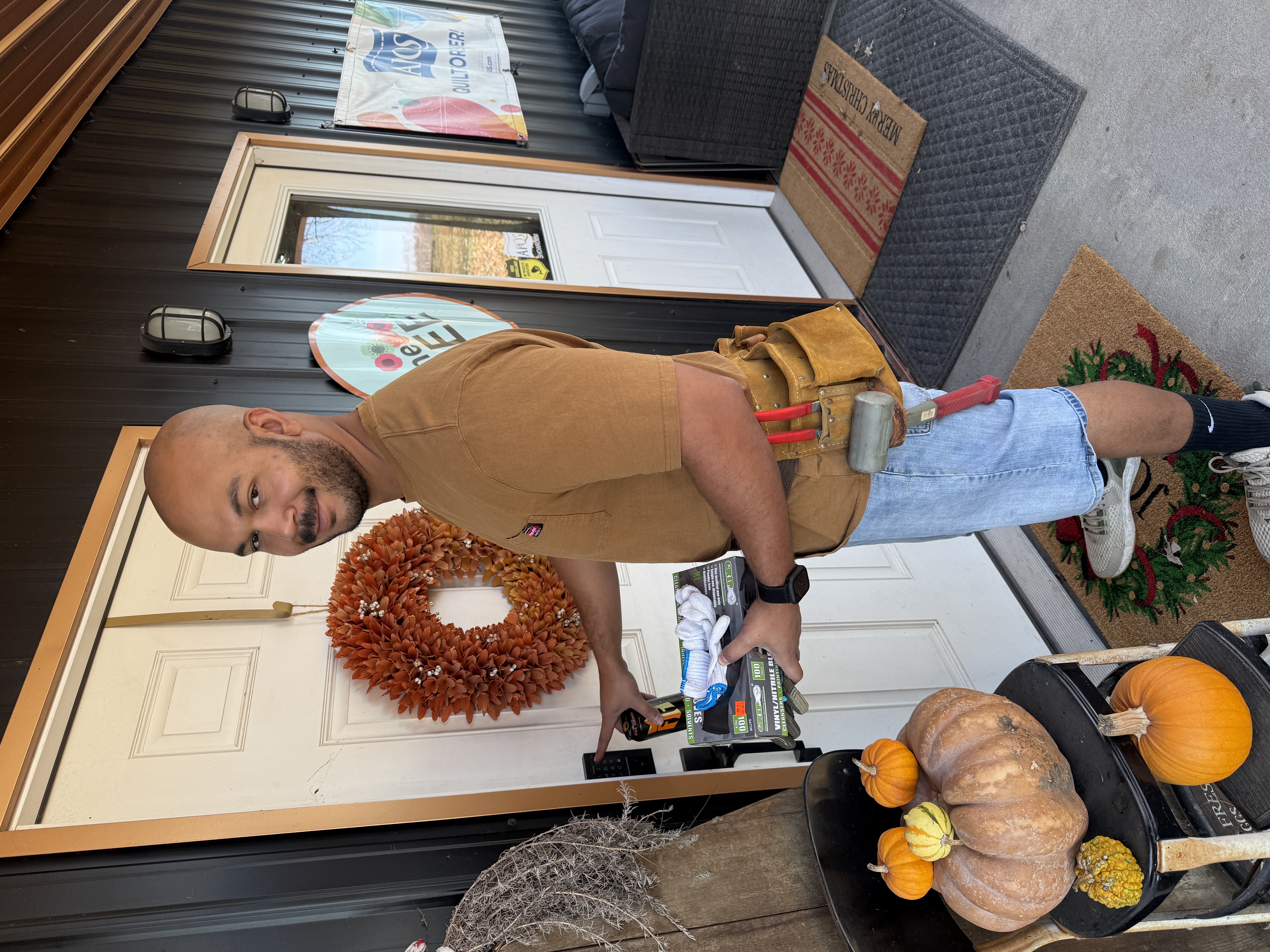
Since the stroke and craniotomy, Justin takes a blood thinner twice a day to help dissolve the blood clot, which could take up to a year.
Now Justin is continuing his recovery with physical, occupational, and speech therapy at Saint Luke’s North Hospital–Smithville, where a coordinated rehab team is helping him rebuild strength, memory, and communication.
“There's still a long road ahead to get back to where I was,” he says. “The therapy has all helped a lot. I struggle with my memory at times, but it's gotten a lot better. I can carry a conversation now instead of having to play charades, like when I asked Nicole to marry me.”
While they had discussed marriage in their future, nothing was set before Justin’s stroke.
Justin and Nicole plan to have their full celebration in December—the same calendar year as the stroke—reclaiming 2026 as “our year.”
About Saint Luke’s
Saint Luke's Hospital of Kansas City has consistently earned several prestigious honors for stroke care, including by The Joint Commission as a Comprehensive Stroke Center, and the state of Missouri as a Level I Time Critical Diagnosis Center for Stroke. Nationally, Saint Luke's beats key benchmark numbers for stroke care.
Relevant News
Patient Stories
Healing in Harmony: How Music Helped Bob Recover After Stroke
Patient Stories
After First Signs of a Stroke, Dorothy Finds Lifesaving Care in Under
Patient Stories
Innovative Stroke Protocol Helps Bill Make Up for Lost Time
News
KCTV: May is Stroke Awareness Month
Patient Stories
18 Years After Stroke, Don Is Using His Hand Again
News