Targeted Radiation Therapy Helps Christina Get Her Memory Back
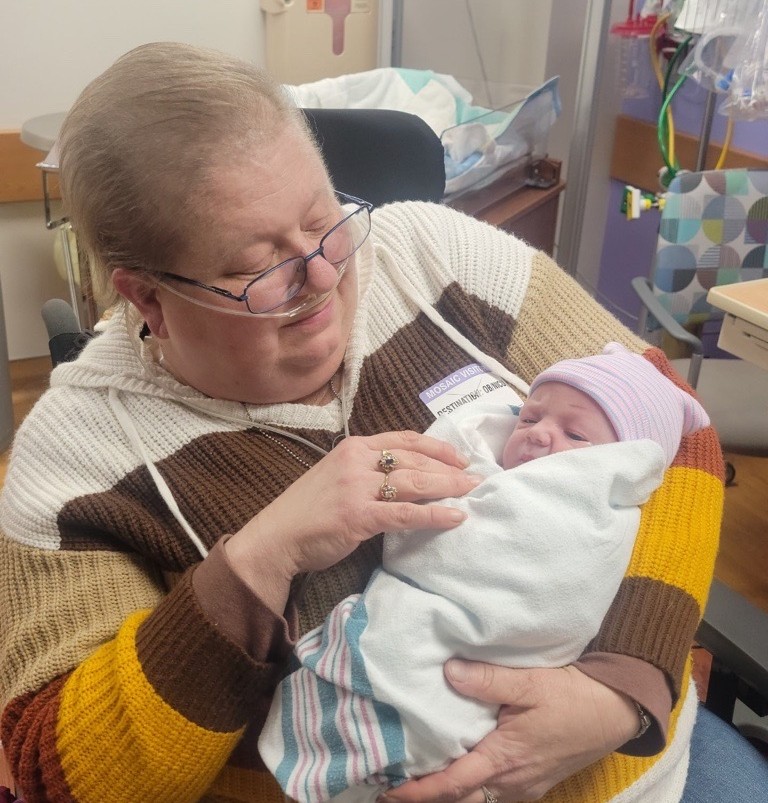
When Christina Woolard, 54, learned she needed brain surgery, she immediately thought about her two sons.
“Both were getting married that September,” Christina says. “I wanted to be there for them.”
While Christina was focused on the weddings of her children, her care team at Saint Luke's was developing a treatment plan for her brain tumor. As part of her treatment, Christina became the first patient at Saint Luke's to receive GammaTile® therapy, a pioneering treatment that targets cancer cells.
With the support of her care team and family, Christina can focus on what matters: making more memories with the people she loves most.
Life-changing diagnosis
Christina’s symptoms began in June 2019. She was having difficulty walking and frequently losing her balance. At times, she felt as though one of her legs could not support her weight.
After visits to hospitals near her home in Atchison, Kansas, a CT scan and MRI revealed Stage 4 non-small cell carcinoma, which was causing her issues. Her care team treated the cancer with radiation, but by 2021, the radiation had little effect. The cancer had spread to her bones, muscles, and organs.
With guidance from her care team to transfer to a hospital better equipped to handle complex cancers, Christina chose Saint Luke’s Hospital of Kansas City.
Around this time, Christina began experiencing severe headaches, which a brain MRI found to be a tumor. Her memory began to slip.
“I wasn’t keeping track of things,” she says. “I couldn’t remember names or what I was trying to say.”
Christina worried about the impact of her memory on her relationships and was frustrated at having to rely on others. Now that the cancer had spread to her brain, she needed a new approach.
Jonathan Breshears, MD, a neurosurgeon specializing in brain and skull base tumors at Saint Luke’s Marion Bloch Neuroscience Institute, had a solution.
One surgery, two treatments
Dr. Breshears and the multidisciplinary team of brain tumor experts at Saint Luke’s suggested treating Christina’s tumor with GammaTile radiation therapy. During surgery, her team would remove the tumor and place small collagen tiles containing radiation directly in the area where the tumor had been.
About the size of a postage stamp, each tile delivers radiation to remaining tumor cells while limiting exposure to healthy brain tissue. The body naturally absorbs the collagen tiles over time.
Because treatment begins immediately at the surgical site, the GammaTile can also reduce the need for patients to return for repeated radiation sessions.
“That meant our team could remove Christina’s tumor and immediately begin targeted radiation,” Dr. Breshears says.
Christina hesitated, she said, only so she could be present for her sons’ weddings before undergoing surgery and beginning her recovery. Once those celebrations were behind her, Christina moved forward with the procedure.
Within six months, she began to feel a significant difference.
“My head's actually 100% better,” Christina says. “I could remember things without having to have my husband tell me what I was trying to say.”
Christina also felt supported beyond the operating room. Because she lives in Atchison, traveling to Kansas City for every follow-up appointment is difficult—about an hour each way. Whenever she doesn’t need an in-person examination, the neuroscience team connects with her virtually while her neuro-oncology nurse calls regularly to check on her progress.
Christina said Dr. Breshears and her radiation oncologist, Susan Herzberg, MD, coordinated with her local oncologist, so her care is seamless despite crossing systems.
“I find it really nice that all three of them talk and work together as a team,” she says. “I have cancer, and they all know how it’s progressed. They work together, not as individual people.”
That collaborative approach reflects Saint Luke’s comprehensive neuro-oncology model, which brings together specialists in neurosurgery, neuro-oncology, radiation oncology, neuroradiology, neuropathology, nursing, and other disciplines to develop one coordinated treatment plan.
Living with Stage 4
Christina remains Stage 4. A tumor in her lungs is stable, neither growing nor shrinking. Every three months, she receives a PET scan near her home and meets with her oncologist.
The news about her brain has been encouraging. There has been no new growth, and her brain function continues to improve. Christina’s future still includes appointments, scans, and uncertainty. But it also includes the memories she feared she might lose.
The GammaTile treatment addressed both her brain tumor and restored her ability to recall a name, complete a thought, and remain fully present for her loved ones—for weddings and the many celebrations to follow.
“I’m really glad this procedure allowed me to get my senses and memory back,” she says. “It may sound scary, but it’s worth it in the long run. I hope it works for everybody else as well as it did for me.”
About Saint Luke’s Marion Bloch Neuroscience Institute
Saint Luke’s Marion Bloch Neuroscience Institute has the region’s most responsive and experienced neuro-oncology team treating brain and spine tumors at every phase. From initial diagnosis to second opinion and recurrence, our multidisciplinary team creates personalized treatment plans tailored to each patient.
Saint Luke’s is also Kansas City’s only GammaTile Center of Excellence, a designation based on clinical experience, contributions to the advancement of the therapy, patient outcomes, and patient education.
Relevant News
Patient Stories
How One Retreat Helped Kathy Find Peace During Her Cancer Journey
News
96.5 The Fan: Chiefs Player Josh Simmons Placed On Injured Reserve: Neurosurgeon Explains the Injury
Patient Stories
5 Years After Stage 4 Breast Cancer Diagnosis, a New Treatment Helps Lori Defy the Odds
Patient Stories
Hip Replacement Helps LeeAnn Find a Good Night’s Sleep
Patient Stories
Walking a New Path: How One Patient Turned Pain Into Passion
Patient Stories