Runner Finishes Half Marathon 144 Days After Heart Surgery
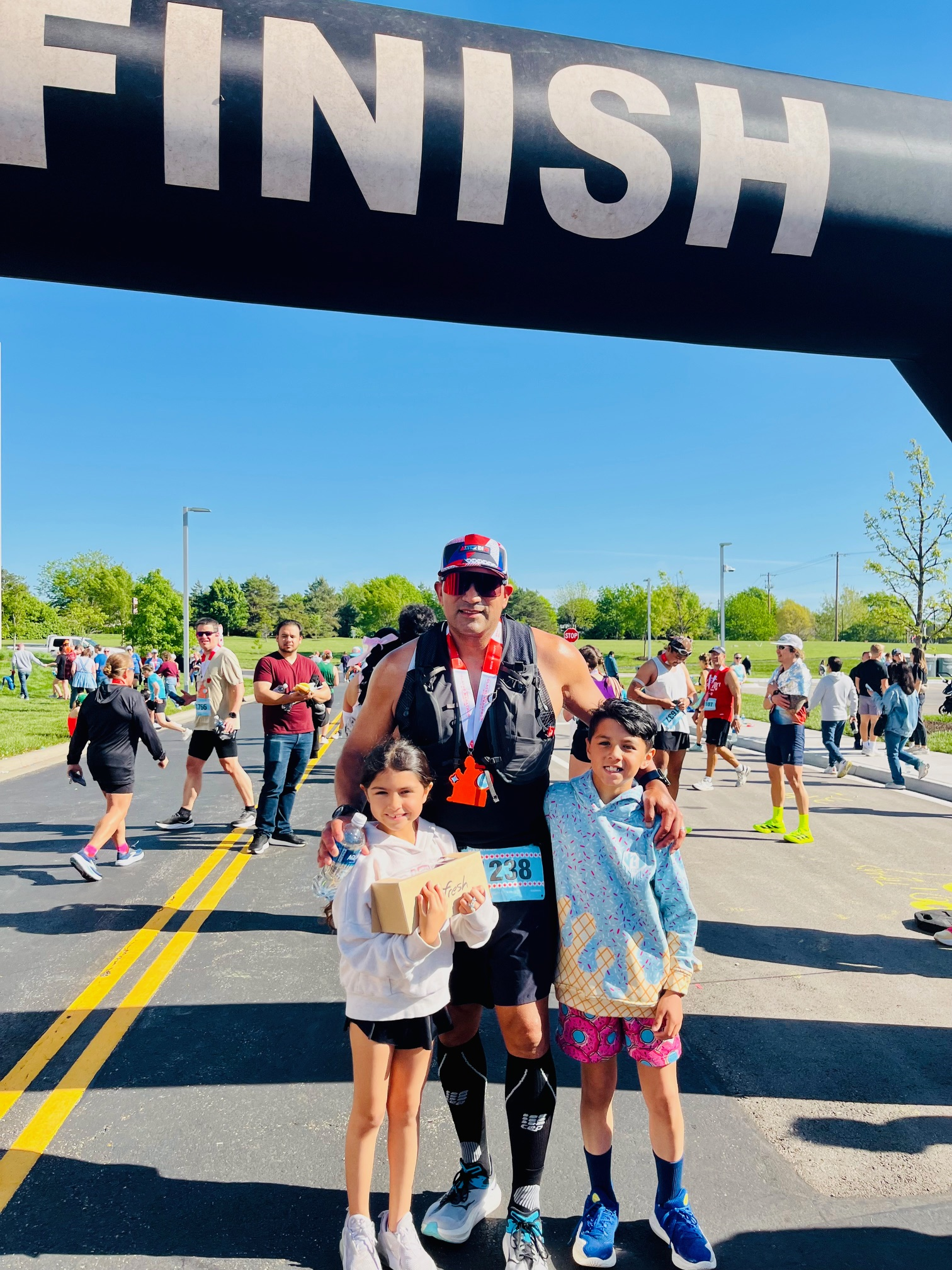 For the first 11 miles of the Garmin Olathe Half Marathon, Richard Trujillo monitored his heart rate on two separate devices to ensure he maintained a healthy range. The stakes were too high.
During the final stretch, he felt stronger than he had in months. He kicked into high gear and passed numerous runners on his way to the finish line.
“My racing pace was much faster than any of my training miles,” Richard says. “It was a great experience to finish fast with no problems.”
The “problems” were ostensibly solved 144 days before the race, when Richard had major heart surgery. This was the first time he truly pushed his endurance since the procedure.
The fact he was even standing at the starting line surprised most of those who knew him. Just months before, the Kansas City husband and father of two had learned he was living with a life-threatening blockage in one of the heart's most important arteries.
But thanks to the expertise of cardiothoracic surgeon Alexander Pak, MD, and the specialists at Saint Luke’s Mid America Heart Institute, Richard went from having a life-threatening situation to running 13.1 miles.
The widowmaker
In late summer 2025, Richard decided to lace up after a break from running and train for the Kansas City Half Marathon.
He handled his 11-week training plan well—10-to-12-mile runs were no problem. That was until two weeks before the race when his runs felt unusually strenuous. Richard’s primary symptom was a burning sensation in his throat during runs, which he assumed was acid reflux.
Concerned, Richard sought medical attention.
His primary care provider sent him to a cardiologist as a precaution. Richard’s cardiologist, part of another health system, recommended a heart catheterization because his symptoms could be related to coronary blockage.
Testing revealed a shocking diagnosis: 100% blockage of his left anterior descending artery (LAD). This condition is often called the “widowmaker” because it can lead to sudden death when not treated immediately.
As a husband and father of a 10-year-old son and 7-year-old daughter, Richard’s diagnosis was most surprising because he felt healthy as long as he wasn’t exercising. But chest pain caused by reduced blood flow (angina) often occurs when the heart is stressed.
“It was an extremely scary diagnosis,” Richard says. “I was walking around wondering what could happen tomorrow or next week while waiting for surgery? That was tough.”
Race to an answer
Complicating matters, his care team discovered a blood clot in his heart’s left ventricle, ruling out a stent as a viable treatment. Surgery appeared to be the safest path forward.
As he waited for the next steps, Richard grew increasingly anxious given the severity of his condition. So he researched leading heart programs in the region who could help him faster. His search led him to Saint Luke's Mid America Heart Institute and Dr. Pak.
After reviewing Richard's scans and catheterization results, Dr. Pak recommended immediate surgery.
On Dec. 1, 2025, Dr. Pak and his surgical team performed a triple coronary artery bypass graft (CABG), a major procedure that restores blood flow to the heart by creating a new pathway around blocked arteries.
In this case, Dr. Pak used three arteries to create the bypass, which came from his chest and arm.
"Using arterial conduits over leg veins, when possible, can improve long-term patency (state of being open) of bypass grafts," Dr. Pak says.
Back to the starting line
After the procedure, Richard spent four nights in the hospital and progressed faster than he anticipated.
Within days of returning home, he was running on the treadmill. Within a few weeks, he was walking 60 to 90 minutes at a time.
No significant chest pain. No surgical complications. Minimal discomfort from his sternotomy incision. Richard says the most uncomfortable part of recovery was where the artery had been taken from his arm.
Richard’s monitored exercise program for cardiac rehabilitation at Saint Luke’s was almost too easy—his pre-surgery fitness level helped him quickly pass through the program.
By January 2026, his doctor cleared him for normal activity, which is when Richard decided to train for the Olathe half marathon, taking place in April. He gradually resumed running and a month before the race, he was completing up to 10- and 11-mile training runs.
While a full recovery from CABG usually takes three to six months, Richard ran a 13.1-mile race after only four months.
Richard is running five to eight miles regularly with no setbacks.
Now that he already has one race under his belt since surgery, Richard is ready for more.
“Things are going really well right now,” he says. “This achievement would not have been possible without the expertise and dedication of Dr. Pak, the surgical team, the post-operative nurses, and the specialists at Saint Luke’s cardiac rehabilitation center."
About Saint Luke’s Mid America Heart Institute
With more than 100 full-time board-certified cardiovascular specialists on staff, Saint Luke’s Mid America Heart Institute offers one of the country's largest heart failure and heart transplant programs, has the largest experience with transcatheter aortic valve replacement in the Midwest, and is a global teaching site for the newest approaches in coronary revascularization.
Learn more about the Heart Institute.
Relevant News
Patient Stories
Walking a New Path: How One Patient Turned Pain Into Passion
News
Health News You Can Use: Saint Luke's Complex Aorta Disease Program
Patient Stories
16,000 Steps A Day: Gina’s Bariatric Surgery Transformation
Patient Stories
Wife’s Quick Thinking Helps Husband
Patient Stories
Emergency Heart Care Helps Joan Celebrate Life’s Big Moments
Patient Stories