Rare Condition, Rapid Care: SCAD Diagnosis Leads to Lifesaving Surgery

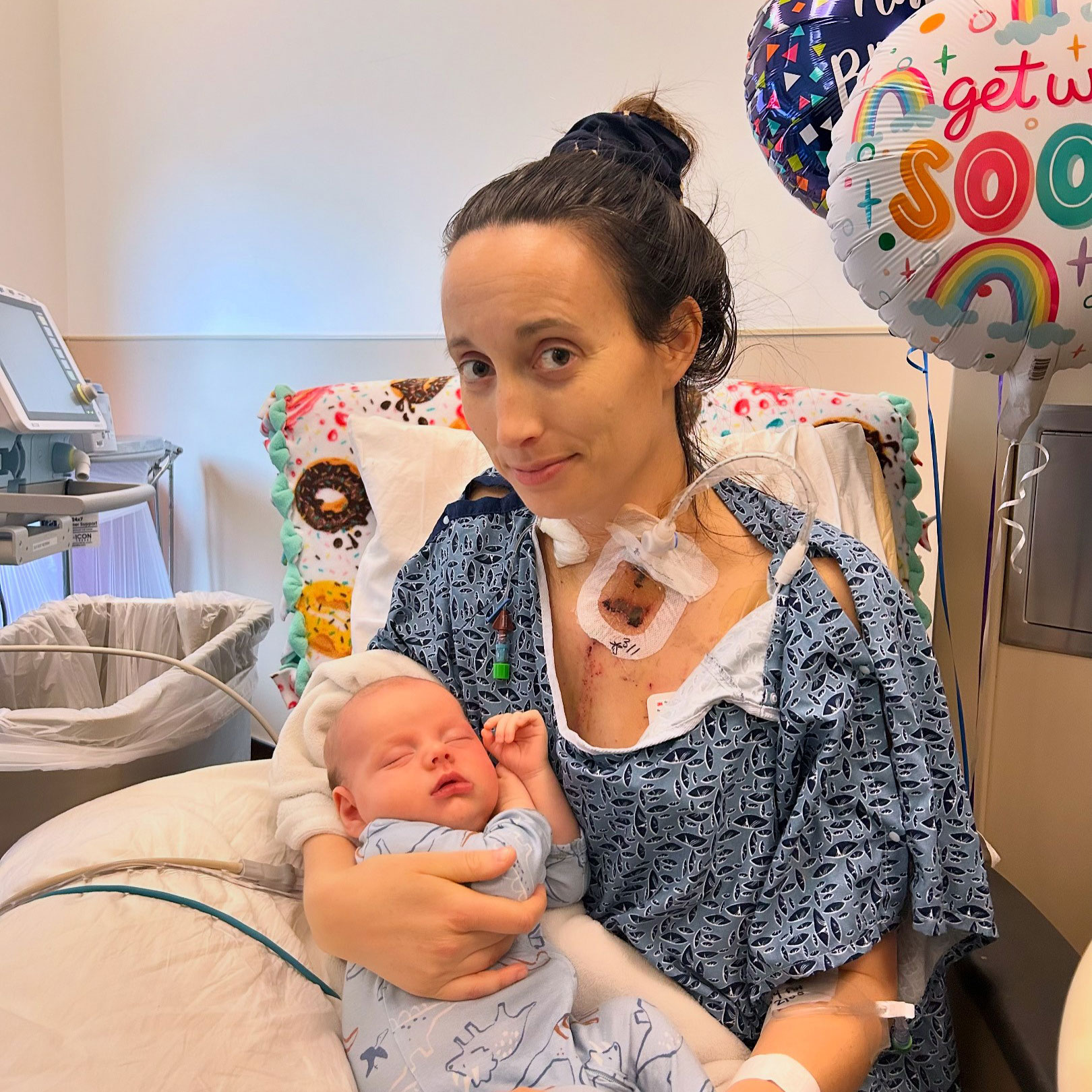
Just six weeks after giving birth to her third child, 34-year-old Layne Strookman of Kansas City was settling into the joys of motherhood. A nurse practitioner at Saint Luke’s Urgent Care and longtime distance runner with no history of medical conditions, Layne had every reason to feel confident in her health. But a routine school dropoff in February 2025 became a turning point in Layne’s life after she was diagnosed with a rare and often overlooked heart condition. Fortunately, she turned to her colleagues at Saint Luke’s Mid America Heart Institute, who acted quickly to intervene and guide her through an extraordinary recovery.
“It was a normal day,” Layne says. “I was taking my two older kids to school, and they were so excited to show off their new baby brother to their teachers.”
But as Layne pulled into the school parking lot, something felt off. A burning sensation in her chest began to set in. As her hands went numb, Layne felt lightheaded. She decided to visit the school nurse and take her vitals, which showed a worrying combination of low pulse and elevated blood pressure. The school nurse called an ambulance immediately.
“It was hard to wrap my head around at the time,” Layne says. “One minute I feel great—the next I’m headed to the Emergency Department.”
Layne was taken to Saint Luke’s Hospital of Kansas City, where tests found elevated levels of cardiac enzymes, a clear sign that something serious was happening in her heart. Interventional cardiologist Aaron Grantham, MD, rushed her to the cardiac catheterization laboratory, where imaging revealed a spontaneous coronary artery dissection, or SCAD. SCAD is a rare condition that occurs when a tear or bruising, such as hematoma, forms in the coronary artery and interrupts blood flow to the heart, often causing a heart attack. It typically occurs in individuals with minimal risk factors for traditional heart disease. Its exact causes are still unknown, but potential risk factors include genetic predisposition, stress, pregnancy, chronic inflammatory conditions, and connective tissue conditions.
Most patients who experience SCAD recover on their own without need for surgery, but studies show a 15–20% recurrence or propagation rate of SCAD in the first week after an episode. Layne was monitored in the hospital for two days and discharged with a firm directive to return to the Emergency Department if she noticed worsening symptoms. Just 20 hours later, that same chest pain returned, and Layne was back in an ambulance, where it was confirmed she was suffering a heart attack.
Layne was taken emergently for repeat heart catheterization. She had developed critical occlusions of both heart arteries on the left side of her heart, and was in acute heart failure for which she required immediate cardiac surgery. A device to support her heart while awaiting emergent bypass surgery was placed by interventional cardiologist Adam Salisbury, MD. Jessica Heimes, DO, cardiothoracic and heart transplant surgeon, was driving into work when she got the call.
“Adam called me and said we had a young, healthy woman who had SCAD and was in cardiogenic shock,” Dr. Heimes says. “What tends to happen in SCAD patients is that the layers of the coronary artery separate and obstruct blood flow to the heart. That was the case for Layne’s entire left coronary system, so I performed a three-vessel bypass to restore blood flow.”
While Layne was in surgery, doctors cautioned her family that Layne’s condition could be beyond recovery. Cardiologists use ejection fraction, a measurement of how much blood the heart pumps out with each beat, to gauge heart function. At a 15% ejection fraction, Layne’s heart was well within the range where doctors may recommend a heart transplant. That was the primary concern for Anthony Magalski, MD, a heart failure and transplant specialist with Saint Luke’s Cardiovascular Consultants and Saint Luke’s Mid America Heart Institute, another member of Layne’s care team.
“After Layne’s bypass surgery, we began to think about a heart transplant,” Dr. Magalski says. “It was a difficult and emotional situation for everyone—but I had a lot of faith in our team and the collaborative approach we were taking with Layne.”
That team included leading experts in women’s heart care from across Saint Luke’s, including Dr. Heimes, Dr. Magalski, and Anna Grodzinsky, MD. Dr. Grodzinsky is a non-invasive cardiologist and accomplished researcher who leads the SCAD program at Saint Luke’s Muriel I. Kauffman Women's Heart Center. She refers to Layne’s case as proof that SCAD research saves lives.
“This was the worst SCAD event we’d ever seen at Saint Luke’s,” Dr. Grodzinsky says. “Layne is our first patient to ever require a bypass surgery as a result of SCAD. This was a first for many of us on the team. But thanks to the team here and our colleagues around the world, we know so much more about this condition than we did even 10 years ago. That made a world of difference for Layne.”
In the days following surgery, Layne’s ejection fraction began to improve—and further heart transplant discussions were deferred. After 12 days in the ICU, Layne was finally able to move to the cardiac floor, where she reunited with her kids in a long overdue moment of joy.
“I didn’t want my kids to see me in the ICU,” Layne says. “I worried it was too intense for them. When I finally saw them on the cardiac floor, it was a rush of emotions like I had never felt before.”
After two weeks in the hospital, Layne came home ready to begin the long road to recovery. Cardiac rehabilitation became her safe space, a place to regain confidence in a body that brought three kids into the world and once ran for dozens of miles at a time. Some days were more challenging than others, but Layne pushed on with the confidence that she had already overcome impossible odds.
“During my first week home, I remember begging to get my life back,” Layne says. “But I can’t go back to that version of myself. My life has changed. I have scars on my chest, and I hope they inspire my kids to feel like they can do anything. When I left the hospital, I asked Dr. Heimes where I go from here. And she told me, ‘Go. Live your life. You’ve made it through the hardest things.’”
Today, Layne is living a full and active life. She runs in moderation, cares for her three kids, and has embraced a new normal with gratitude and perspective. She plans to start a support group in the Kansas City region for those impacted by SCAD and raise awareness for physical and mental realities of this rare condition. While her life looks different now, she says it’s fuller in ways she never expected.
“I’m not taking any of this for granted,” Layne says. “I want to be an example for my kids, family, and patients. I am living proof that we are all stronger, smarter, and braver than we think we are.”
Nationally recognized by U.S. News & World Report, Saint Luke’s Hospital of Kansas City is one of Kansas City’s leading research and academic medical institutions and home to the world-renowned Saint Luke’s Mid America Heart Institute. Comprising nearly 100 board-certified experts in cardiology, cardiovascular surgery, and critical care anesthesia, the Heart Institute offers a comprehensive range of treatment options for advanced heart failure, structural intervention, preventive cardiology, electrophysiology, and heart and vascular surgery.
Get more information about the Heart Institute.
Relevant News
Patient Stories
Walking a New Path: How One Patient Turned Pain Into Passion
News
Health News You Can Use: Saint Luke's Complex Aorta Disease Program
Patient Stories
16,000 Steps A Day: Gina’s Bariatric Surgery Transformation
Patient Stories
Wife’s Quick Thinking Helps Husband
Patient Stories
Emergency Heart Care Helps Joan Celebrate Life’s Big Moments
Patient Stories