KC Waitress Served Kansas City’s Biggest Givers. After Her Brain Tumor, Their Gift Served Her.
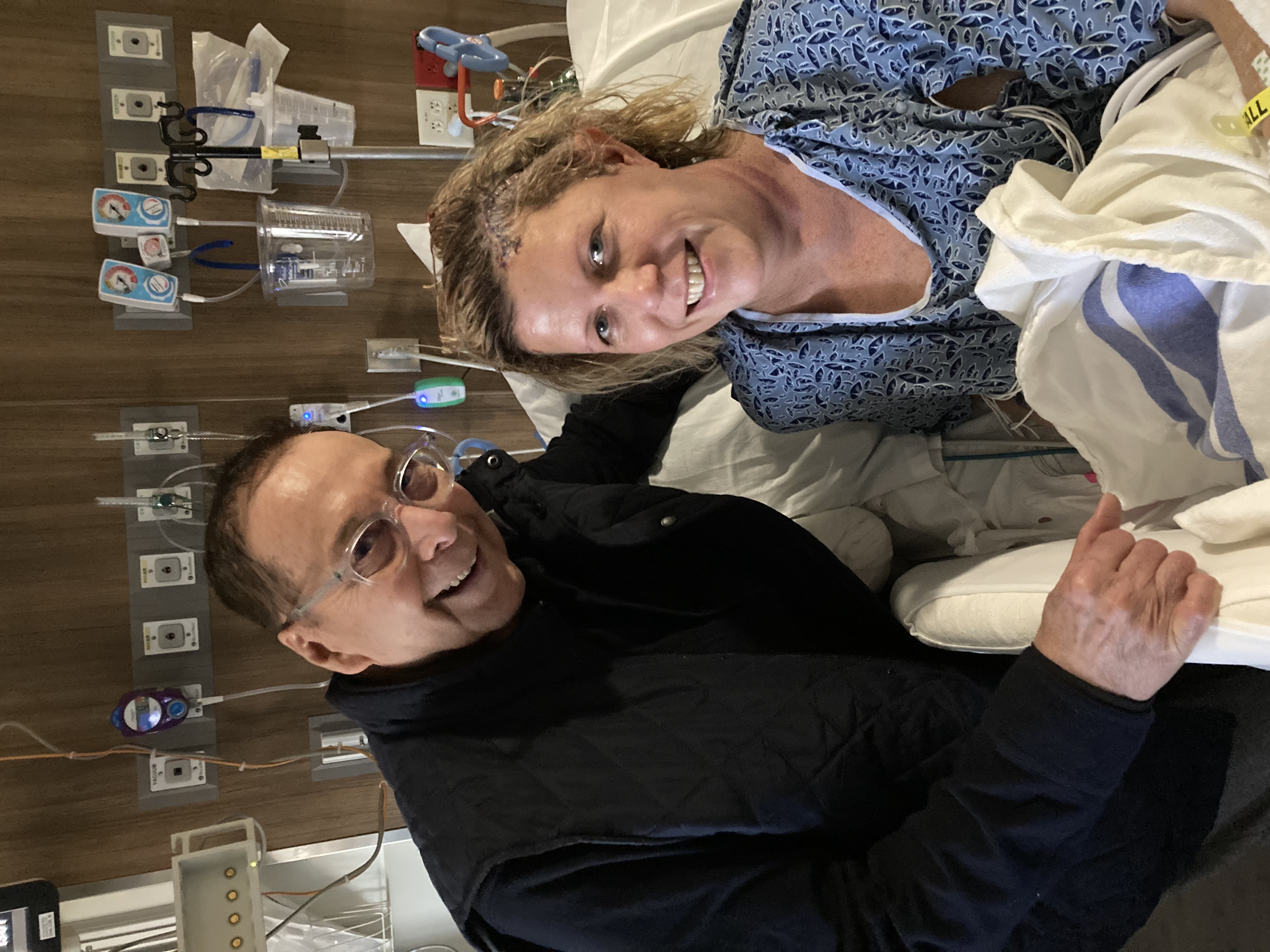 As Jo Ellen Rupp, 56, was leaving Saint Luke’s Marion Bloch Neuroscience Institute, she stopped in front of the sign that featured the Bloch name.
The moment brought her back 30 years to her first server job, when she would wait on the Institute's namesakes, Marion and Henry Bloch.
“They were regulars and waiting on them made you feel like you were part of their group,” Jo Ellen said. “We became friends and they even followed me around to a couple other restaurants.”
The Blochs always kept conversations grounded in family and friends, but Jo Ellen knew about their generous contributions across Kansas City. Still, as a young waitress, the smallest moments made the biggest impact.
“We didn’t wear name tags,” Jo Ellen says of her job at the time. “One night, after I had only waited on them a couple of times, Henry came in and called me by my first name. I thought that was pretty extraordinary.”
Decades later, as Jo Ellen was leaving the Institute after being treated for a brain tumor, she took a photo of herself in front of the sign and sent it to one of her friends in the Bloch family. The moment gave her hospital experience a poetic touch.
“It felt really special to be treated at Saint Luke’s,” she says.
Subtle signs of a brain tumor
Jo Ellen noticed the symptoms of the brain tumor only a few days before it was removed.
The signs were subtle, which is why brain tumors can be so dangerous.
In December, while writing down an order at The Capital Grille, Jo Ellen noticed her handwriting was uncharacteristically sloppy. And thinking about it now, the fatigue she felt around that time was more than just typical holiday season stress.
Jo Ellen worked 16 days in a row during Capital Grille’s busy season before spending Christmas Day on the 20-yard line at the Kansas City Chiefs game. The next day, she hosted a big family get-together.
On Saturday, Dec. 27, 2025, Jo Ellen woke up and felt off. Exhaustion was setting in, she thought. She took her dog, Kelce, on a walk and rested until work. Then, at one point during her shift, she was trying to talk to a group of customers, but the words wouldn’t come.
She told her team members something wasn’t right. Knowing Jo Ellen as someone who took great care of her health, her coworkers were worried. One of her managers asked her a series of simple questions.
“Where are you right now?” Jo Ellen remembers him asking her.
She couldn’t answer. Her team called the paramedics.
“They did not waste any time,” Jo Ellen says. “They put me on a gurney and rolled me through the dining room.”
The ambulance rushed her to Saint Luke’s Hospital of Kansas City for evaluation. Still in her uniform, Jo Ellen was hooked up to an IV, received steroids and an antiseizure medication, and underwent a CAT scan. Shortly after, she regained her ability to talk.
“I thought they were making a big deal out of nothing,” Jo Ellen says. “I was focused on going back to work and finishing what I was doing.”
However, one of the Emergency Department clinicians came by with a CT scan of her brain: Jo Ellen had a tumor in her left frontal region, between the skull and the brain, which was pushing on the brain and causing a large amount of swelling.
Jo Ellen’s doctor told her they were taking her to the intensive care unit and would perform surgery as soon as possible.
97% success
Jo Ellen met Tarek El Ahmadieh, MD, a neurosurgeon with Saint Luke’s Marion Bloch Neuroscience Institute.
“He made me feel better immediately, explaining the chance of success was 97%,” Jo Ellen says. “There was only 3% chance something could go wrong, so I was going to focus on the 97%.”
Dr. El Ahmadieh was immediately struck by Jo Ellen’s positive spirit and energy. Despite the seriousness of the situation, she remained calm.
“Jo Ellen’s tumor appeared benign, but it was located in a very sensitive part of the brain,” Dr. El Ahmadieh says. “It was pressing on an important speech region called Broca’s area, which controls our ability to express language.”
The tumor’s location and the significant amount of brain swelling made the procedure a delicate process. There was a chance of causing injury to nearby blood vessels or highly functional brain tissue, potentially leading to a stroke or speech challenges.
“To safely remove the mass, we used advanced microscopic techniques and carefully worked around the areas responsible for speech,” Dr. El Ahmadieh says. “Our goal was complete and safe removal while preserving Jo Ellen’s ability to speak and function normally.”
The surgery took about six hours in total. And for such a significant procedure, Jo Ellen’s postoperative appearance showed how far micro-neurosurgical advances and techniques have come.
One of Jo Ellen’s managers stayed with her until 1 a.m. while her family drove four hours from Hays, Kansas, to see her just hours after they spent the holidays together. Her mother expected a harrowing sight—her daughter, flat on her back, bandaged, pale skin.
But, aside from a few stitches and a small rim of hair shaved around the incision, Jo Ellen looked like she normally does. And side-effects were minimal as well—no headaches, speech deficits, or noticeable pain. By 4 p.m. Wednesday, two days after surgery, she was back home.
Full circle
Jo Ellen spent a couple days limiting her activity. But after her first check-in appointment, she received the go-ahead to add weights to her lifting and miles to her walking.
Two months later, she’s nearly back to her old self, working and going on long walks with Kelce.
As Jo Ellen looks back on the experience, she’s forever grateful to some of the Institute’s biggest donors—and her extraordinary friends.
“I looked up to the Blochs so much and I loved taking care of them,” Jo Ellen says. “The fact Saint Luke’s took such great care of me—it all came full circle.”
About Saint Luke’s Marion Bloch Neuroscience Institute
Saint Luke's Marion Bloch Neuroscience Institute’s multispecialty team provides the latest minimally invasive spinal surgical techniques to treat acute and chronic back pain. The fellowship-trained neurosurgery team have expertise in subspecialties ranging from asleep deep brain stimulation (DBS) surgery to treating skull-based tumors and everything in between.
The Neuroscience Institute is a comprehensive center for neuroscience research, education, and evidence-based medicine that combines faculty in neurology, neurosurgery, interventional neuroradiology, neurotology, psychiatry, and physical medicine and rehabilitation.
Relevant News
Patient Stories
Walking a New Path: How One Patient Turned Pain Into Passion
Patient Stories
16,000 Steps A Day: Gina’s Bariatric Surgery Transformation
Patient Stories
Wife’s Quick Thinking Helps Husband
Patient Stories
Emergency Heart Care Helps Joan Celebrate Life’s Big Moments
Patient Stories
Healing in Harmony: How Music Helped Bob Recover After Stroke
Patient Stories