Roadside Heroics Lead One Grandfather to Lifesaving Care at Saint Luke’s Mid America Heart Institute
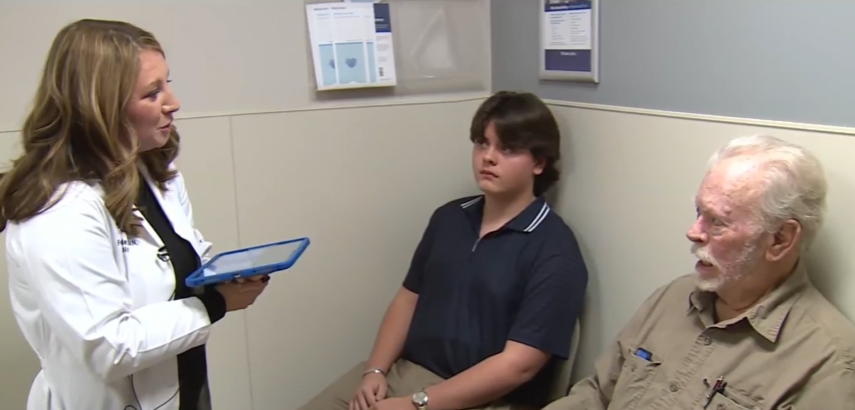
It was a warm, late summer day in Kansas City when Carl Linck, 82, was cruising down Interstate 29 with his 15-year-old grandson riding shotgun. Suddenly, Carl felt a burning sensation at the base of his spine that began creeping upward toward his neck. As he pulled over to the side of the road, his grandson, Parker VanSickle, sprang into action. Parker knew his grandfather had atrial fibrillation, a heart condition causing an irregular rhythm, and grabbed the nitroglycerin pills Carl kept in his pocket for cardiac emergencies.
“If Parker hadn’t been there that day, I’m not sure what would have happened,” Carl says. “He was calm, confident, and did everything right. I’m so proud of him.”
Carl had just taken the pills but was losing consciousness when another good Samaritan arrived on the scene and began CPR on the side of the road. Soon, two others pulled over to assist with moving the car to safety and comforting Parker.
By the time the ambulance arrived, Carl had no pulse. He was resuscitated twice on the way to Saint Luke’s North Hospital–Smithville, where he was admitted and stabilized. The next day, he was transferred to Saint Luke’s Hospital of Kansas City for advanced treatment at Saint Luke’s Mid America Heart Institute.
Carl met with Andrew Sauer, MD, and Jonathan Enriquez, MD, both board-certified and fellowship-trained cardiologists, who determined that Carl had gone into cardiac arrest as a result of severely weakened heart muscle, called cardiomyopathy. In addition to appropriate testing and medication, they recommended a special pacemaker/defibrillator along cardiac resynchronization therapy (CRT) to correct Carl’s heart rhythm and restore normal function.
“Given Carl’s weak heart and cardiac arrest, the defibrillator was essential,” says Dr. Sauer. “It can also act as a pacemaker to keep his heart rhythm stable, improve his heart function, and provide immediate support if his heart ever stops again. It’s lifesaving protection for someone with his condition.”
An implantable defibrillator is a battery-powered device positioned below the collarbone to detect irregular heartbeats. If it detects an irregular heartbeat, it can deliver a small electrical shock to force the heart back into rhythm.
“Carl’s procedure represents an innovative pacing technique performed at some of the most advanced centers in the world, like Saint Luke’s Mid America Heart Institute,” says Dr. Enriquez. “Combined with the lifesaving function of a defibrillator, patients are not only protected from sudden cardiac death and can live longer, but also recover heart function and feel better with fewer complications.”
Throughout his procedure and recovery, Carl says his nurses made all the difference. “I pushed a button—and there they were,” Carl says. “I came away with a deep respect and appreciation for nurses. They go through a lot, but they always showed up for me with big smiles.”
Today, Carl is back home and doing well. In a few weeks, he’ll trade the Kansas City winter for the sunny skies of southern Florida, where he spends every winter with his wife of 50 years, Linda. Looking back, he calls that fateful day on the highway nothing short of a blessing, one that saved his life and renewed his faith in others.
“I was surrounded by kindness at every turn,” Carl says. “From my grandson to the paramedics to the doctors at Saint Luke’s, everyone went the extra mile to care for me.”
Comprising nearly 100 board-certified experts in cardiology, cardiovascular surgery, and critical care anesthesia, Saint Luke’s Mid America Heart Institute offers a comprehensive range of treatment options for advanced heart failure, structural intervention, preventive cardiology, electrophysiology, and heart and vascular surgery.
Learn more about the Saint Luke's Mid America Heart Institute.
Relevant News
Patient Stories
Walking a New Path: How One Patient Turned Pain Into Passion
Patient Stories
16,000 Steps A Day: Gina’s Bariatric Surgery Transformation
News
Media Coverage: Saint Luke’s Hosts Annual NICU Reunion for Former Patients
Patient Stories
Wife’s Quick Thinking Helps Husband
Article
Health News You Can Use: Saint Luke's Crohn's and Colitis Center of Excellence
Patient Stories