Living Kidney Donation
Patients who receive organs from living donors tend to have better outcomes than those who receive organs from deceased donors. Our living kidney donor experts perform living kidney donor surgeries and offer personalized support and unmatched expertise to donors who consider this selfless act.
Why choose us for living kidney donation?
Saint Luke’s is a leader in kidney transplantation, performing the first successful kidney transplant in the Kansas City area in 1969 and the first living kidney donation surgery via laparoscopy in the region. Saint Luke’s physicians deliver excellent transplant care and offer a comprehensive living donor program to provide a high level of care to living kidney donors. We offer:
- Expertise: Our providers have a depth of experience that leads to excellent short- and long-term results.
- Convenience: Our living-kidney coordinator helps you navigate the entire evaluation process. Their personalized care makes the process convenient, friendly, and efficient. We also accommodate donors who live outside of the area, allowing them to perform most of their eligibility testing at a location convenient for them.
- Minimally invasive approach: Our team offers minimally invasive procedures for kidney donation surgery, meaning you have smaller scars and a quicker recovery.
- Enhanced recovery protocols: Our research-backed recovery process allows living kidney donors to experience less pain after surgery. We work to make sure you are comfortable upon returning home.
About Living Kidney Donation
A kidney transplant is a surgery to put a donated kidney into your body. It is the preferred treatment for kidney failure. The new kidney takes over the job of filtering your blood.
Finding a new kidney
The new kidney may come from:
A living person (living donor)
A person who has recently died (deceased donor)
Living donor kidney
Living donor kidneys work much longer than deceased donor kidneys. For this reason, you are strongly encouraged to talk with your friends and family. But the donor does not have to be related to you. Their kidney must match your blood type and immune system. A person can safely donate a kidney if they are in good health and pass all the medical tests.
Deceased donor kidney
For this, permission is needed from the donor's family. There is a waiting list for kidneys from deceased donors. The list ranges from months to years. This depends on your blood type.
Preparing for surgery
You must have a series of tests in the transplant center. These are done to make sure you are eligible for transplant. Tests are done to make sure you don't have any serious infections. These include AIDS and hepatitis B.
Your vital organs need to be working well. This includes your heart and lungs. They must be able to endure the surgery and the antirejection medicine (see below).
A social worker will talk with you. They will ask about your financial situation and social support.
Your healthcare provider will explain your roles and responsibilities with the new kidney. Your commitment is important. You will need to keep the kidney healthy and working for a long time.
Your healthcare provider will talk with you about the possible complications of surgery. They will talk about the side effects of the medicines you will need to take after transplant.
Tests are done to make sure that the donor kidney matches your body's blood type and immune system. This can prevent a sudden rejection after the transplant.
During the transplant surgery
The surgery usually takes about
3 to 6 hours.All kidneys are screened for disease before the transplant.
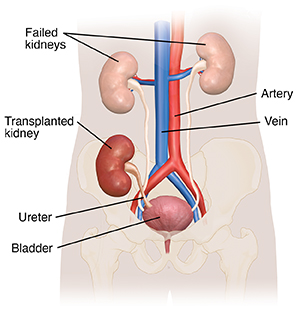
In most cases, your kidneys will not be removed. This is because even failed kidneys release chemicals that help your body work.
The new kidney is placed in the lower part of your belly (abdomen) near your groin.
It is attached to nearby blood vessels. Blood can then flow through to be filtered.
The ureter is connected to your bladder to let urine flow out.
Recovering from surgery
You will recover in the hospital after surgery. A living donor may stay in the hospital for up to a week. You may stay longer. Your new kidney may start to work right away, especially if it's from a living donor. Or it may take a few weeks if it's from a deceased donor. You will be told what to do and not to do while you’re healing.
Taking antirejection medicine
Your body's immune system will try to damage the new kidney right after the surgery. This is called acute rejection. Taking antirejection medicines right after the surgery can stop this. You will need these for the rest of your life as long as your kidney is working. This is to keep your body from rejecting the transplanted kidney. Your healthcare team will discuss the side effects of these medicines with you.
You will need to watch your health for signs of kidney rejection. These include:
Less urine output
Fever
Pain at the site of your new kidney
Weight gain
Notes for a donor
Here are some things to know before donating a kidney:
You can only donate if your blood type is compatible with the recipient's blood type. Other types of matching will also be done. You may need to stay in the hospital for 24 to 48 hours to have tests.
You will be given a full medical checkup. This is to make sure you are healthy enough to donate.
Your kidney is usually removed by a laparoscopic method. This uses a few small incisions. In some cases, an open procedure is used. This is done with a longer incision. Recovery time is longer after an open procedure.
You have 2 kidneys. When you have 1 kidney removed, your other kidney will take over and keep you healthy. Talk with your provider about the possible complications of surgery.
Some of the costs of donating a kidney are covered by the recipient's insurance. Talk with the social worker to get all cost and insurance information.
The need for kidneys to transplant continues to increase. If you want to donate a kidney when you die, go to www.organdonor.gov. You can also learn more at www.transplantliving.org.
What is a kidney transplant?
A kidney transplant is a surgery done to replace a diseased or injured kidney with a healthy kidney from a donor. The kidney may come from a deceased donor or from a living donor. Family members or others who are a good match may be able to donate one of their kidneys. This type of transplant is called a living transplant. People who donate a kidney can live healthy lives with one healthy kidney.
A person getting a transplant most often gets just one kidney. In rare situations, they may get two kidneys from a deceased donor. The diseased kidneys are usually left in place. The transplanted kidney is placed in the lower belly on the front side of the body.
Why might you need a kidney transplant?
You may need a kidney transplant if you have end-stage renal disease (ESRD). This is a permanent condition of kidney failure. It often needs dialysis. This is a process used to remove wastes and other substances from the blood.
The kidneys:
- Remove urea and liquid waste from the blood in the form of urine. Urea is made when foods containing protein, such as meat, poultry, and certain vegetables, are broken down in the body. Urea is carried in the blood to the kidneys.
- Balance salts; electrolytes, such as potassium and sodium; and other substances in the blood.
- Make erythropoietin, a hormone that helps red blood cells form.
- Regulate blood pressure.
- Regulate fluid and the acid-base balance in the body to keep it neutral. This is needed for normal function of many processes within the body.
Some conditions of the kidneys that may result in ESRD include:
- Repeated urinary infections.
- Kidney failure caused by diabetes or high blood pressure.
- Polycystic kidney disease or other inherited disorders.
- Glomerulonephritis, which is inflammation of the kidneys' filtering units.
- Hemolytic uremic syndrome, a rare disorder that causes kidney failure.
- Lupus and other diseases of the immune system.
- Obstructions.
Other conditions, such as congenital defects of the kidneys, may result in the need for a kidney transplant.
There may be other reasons that lead your doctor to recommend a kidney transplant.
What are the risks of kidney transplant?
As with any surgery, problems can occur. Some may include:
- Bleeding.
- Infection.
- Blockage of the blood vessels to the new kidney.
- Leakage of urine from or blockage of urine in the ureter.
- Lack of function of the new kidney at first.
The new kidney may be rejected. Rejection is a normal reaction of the body to a foreign object or tissue. When a new kidney is transplanted into a recipient's body, the immune system reacts to what it thinks is a threat and attacks the new organ. For a transplanted organ to survive, medicines must be taken to trick the immune system into accepting the transplant and not attacking it as a foreign object.
The medicines used to prevent or treat rejection have side effects. The exact side effects will depend on the specific medicines that are taken.
Not everyone is a candidate for a kidney transplant. You may not be eligible if you have:
- A current infection, or recurring infections, that cannot be treated effectively.
- Cancer that has spread from its original location to elsewhere in the body.
- Severe heart or other health problems that make it unsafe to have surgery.
- Serious conditions other than kidney disease that would not get better after the transplant.
- Not followed the treatment plan.
There may be other risks depending on your specific medical condition. Before the procedure, be sure to discuss any concerns with your transplant team.
How do you get ready for a kidney transplant?
To get a kidney from an organ donor who has died (cadaver), you must be placed on a waiting list of the United Network for Organ Sharing (UNOS). Extensive testing must be done before you can be placed on the transplant list.
A transplant team carries out the evaluation process for receiving a kidney. The team includes a transplant surgeon, a transplant nephrologist (doctor specializing in the treatment of the kidneys), one or more transplant nurses, a social worker, and a psychiatrist or psychologist. Other team members may include a dietitian, a chaplain, your primary doctor, and an anesthesiologist or nurse anesthetist.
The evaluation includes:
- A mental health evaluation. Psychological and social issues involved in an organ transplant, such as stress, financial issues, and support by family and significant others are assessed. These issues can greatly affect the outcome of a transplant. The same kind of evaluation is done for a living donor.
- Blood tests. Blood tests are done to help find a good donor match, to check your priority on the donor list, and to help the chances that the donor organ won't be rejected.
- Diagnostic tests. Diagnostic tests may be done to check your kidneys as well as your overall health status. These tests may include X-rays, a CT scan, ultrasound, kidney biopsy, and dental exams. Women may get a Pap test, gynecology evaluation, and a mammogram.
The transplant team will weigh all the facts from interviews, your medical history, physical exam, and tests to determine your eligibility for a kidney transplant.
When you've been accepted as a transplant candidate, you are placed on the UNOS list. When a donor organ becomes available, you'll be notified and told to go to the hospital right away.
If you are to get a kidney from a living family member (living-related transplant), the transplant may be done at a planned time. The donor must have a compatible blood type and be in good health. A mental health check will be done to be sure the donor is comfortable with and committed to their decision.
These steps will happen before the transplant:
- Your transplant team will explain the procedure to you, and you can ask questions.
- You'll be asked to sign a consent form that gives your permission to have the surgery done. Read the form carefully, and ask questions if something is not clear.
- If you have been on routine dialysis before the procedure, you will get dialysis before the procedure.
- For a planned living transplant, you should fast for 8 hours before the operation, typically after midnight. In the case of a cadaver organ transplant, you should start to fast as soon as you are told that a kidney has become available.
- You may get a sedative before the procedure to help you relax.
- Based on your medical condition, your transplant team may ask for other specific preparations.
What happens during a kidney transplant?
A kidney transplant requires a stay in a hospital. Procedures may vary depending on your condition and your doctor's practices.
Generally, a kidney transplant follows this process:
- You will remove your clothing and put on a hospital gown.
- An I.V. (intravenous) line will be started in your arm or hand. More catheters may be put in your neck and wrist to monitor the status of your heart and blood pressure, and to take blood samples. Other sites for catheters include under the collarbone area and in the groin blood vessels.
- If there is too much hair at the surgical site, it may be shaved off.
- A urinary catheter will be inserted into your bladder.
- You will be positioned on the operating table, lying on your back.
- Kidney transplant surgery will be done while you're asleep under general anesthesia. A tube will be inserted through your mouth into your lungs. The tube will be attached to a ventilator that will breathe for you during the procedure.
- The anesthesiologist or nurse anesthetist will closely watch your heart rate, blood pressure, breathing, and blood oxygen level during the surgery.
- The skin over the surgical site will be cleansed with an antiseptic solution.
- The surgeon will make a long incision into the lower abdomen on one side. The surgeon will visually inspect the donor kidney before implanting it.
- The donor kidney will be placed into the belly. A left donor kidney will be implanted on your right side; a right donor kidney will be implanted on your left side. This allows the ureter to be accessed easily for connection to your bladder.
- The renal artery and vein of the donor kidney will be sewn to the external iliac artery and vein.
- After the artery and vein are attached, the blood flow through these vessels will be checked for bleeding at the suture lines.
- The donor ureter (the tube that drains urine from the kidney) will be connected to your bladder.
- The incision will be closed with stitches or surgical staples.
- A drain may be placed in the incision site to reduce swelling.
- A sterile bandage or dressing will be applied.
Talk with your doctor about what will happen during your kidney transplant.
What happens after a kidney transplant?
In the hospital
- After the surgery, you'll be taken to the recovery room. When your blood pressure, pulse, and breathing are stable and you are alert, you likely will be taken to the intensive care unit (ICU) for close monitoring. In time, you'll be moved out of the ICU to a regular nursing unit as you recover and as you get closer to going home. Kidney transplant usually means you'll spend several days in the hospital.
- A kidney from a living donor may start to make urine right away. Urine production in a cadaver kidney may take longer. You may need to continue dialysis until urine output is normal.
- You'll have a catheter in your bladder to drain your urine. The amount of urine will be measured to check how the new kidney is working.
- You'll get I.V. fluids until you are able to eat and drink enough on your own.
- Your team will closely watch how your antirejection medicines are working to make sure you are getting the best dose and the best combination of medicines.
- Blood samples will be taken often to check the status of the new kidney, as well as other body functions, such as the liver, lungs, and blood system.
- You'll slowly move from liquids to more solid foods, as tolerated. Your fluids may be limited until the new kidney is working fully.
- Usually, by the day after the procedure, you may start moving around. You should get out of bed and move around several times a day.
- Take a pain reliever for soreness as advised by your doctor. Don't take aspirin or certain other pain medicines that may increase the chance of bleeding. Be sure to take only recommended medicines.
- Nurses, pharmacists, dietitians, physical therapists, and other members of the transplant team will teach you how to take care of yourself after you're discharged from the hospital, including care for your incisions.
- You'll be ready to go home when your vital signs are stable, the new kidney is working, and you no longer need the constant hospital care.
At home
- After you are back at home, it's important to keep the surgical area clean and dry. Your doctor will give you specific bathing instructions. Generally, the incision should not be submerged in water until the skin heals, to avoid the risk of infection. The stitches or surgical staples will be removed during a follow-up office visit.
- You should not drive until your doctor tells you it's okay. Plan to have someone drive you home from the hospital and to your follow-up appointments.
- Avoid any activity or position that causes pressure to be placed on the new kidney. Other activity restrictions may apply.
- Check your blood pressure and weight every day. Increases in these may mean that your kidneys are not filtering fluid properly. You need to be seen by your transplant team right away.
Tell your doctor if you have:
- A fever, which may be a sign of rejection or infection.
- Redness, swelling, or bleeding or other drainage from the incision site.
- Increased pain around the incision site, which may be a sign of rejection or infection.
Fever and tenderness over the kidney are some of the most common symptoms of rejection. A rise in your blood creatinine level (blood test to measure kidney function) or blood pressure may also suggest rejection. The symptoms of rejection may look like other medical conditions or problems. Talk with your transplant team about any concerns you have. Frequent visits to and contact with the transplant team are vital.
Stay away from places where you could be exposed to anyone who may be sick. This is because your immune system will be suppressed to protect you from rejecting the new kidney. This will be a lifelong precaution.
Your care team may give you other instructions after the procedure, depending on your situation.
What is done to prevent rejection
To allow the transplanted kidney to survive in your body, you'll be given medicines for the rest of your life to fight rejection. Each person may react differently to these medicines.
New antirejection medicines are continually being developed and approved. Your care team will tailor a medicine regimen to meet your needs.
Usually several antirejection medicines are given at first. The doses of these medicines may change often, depending on your response. Because antirejection medicines affect the immune system, you'll be at higher risk for infections. A balance must be maintained between preventing rejection and making you very susceptible to infection.
Some of the infections you'll be especially at risk for include oral yeast infection (thrush), herpes, and respiratory viruses. Stay away from crowds and anyone who has an infection for the first few months after your surgery.
Next steps
Before you agree to the test or the procedure, make sure you know:
- The name of the test or procedure.
- The reason you are having the test or procedure.
- What results to expect and what they mean.
- The risks and benefits of the test or procedure.
- What the possible side effects or complications are.
- When and where you are to have the test or procedure.
- Who will do the test or procedure and what that person's qualifications are.
- What would happen if you did not have the test or procedure.
- Any alternative tests or procedures to think about.
- When and how you will get the results.
- Who to contact after the test or procedure if you have questions or problems.
- How much you will have to pay for the test or procedure.
Locations

Saint Luke's Hospital Abdominal Transplant & Multi-Specialty Clinic–Transplant
Saint Luke's Transplant Clinic–Wichita
Relevant News
Article
Giving While Living: Fast Facts About Living Organ Donors
Patient Stories
A Match Made in Denver: One Kidney Patient’s Transplant Journey
News
Health News You Can Use: Donate Life Month
News
Health News You Can Use: Advances in Transplant & Organ Donation
Article
Health News You Can Use: Living Organ Donation
Article