Hearing Disorders
Hearing loss is usually caused by either a temporary blockage or a permanent problem within the ear or brain that keeps sound from being heard or understood.
What is hearing loss?
Hearing loss affects millions of adults in the U.S. Many things can harm hearing. Things that help lead to hearing loss include age-related hearing loss (presbycusis), exposure to loud noise, and hereditary causes. Older adults are the largest group affected by hearing loss. This can happen from:
Too much noise.
Certain medicines.
Infections caused by bacteria or viruses.
Head injury.
Head tumors.
Stroke.
Inherited conditions.
One in 3 older adults over age 60 has hearing loss. Nearly half of people ages 75 to 85 have hearing loss.
When sudden hearing loss happens, it's important to contact your doctor right away. Your doctor will do a medical exam and a hearing exam as soon as possible to help find the cause and type of your sudden hearing loss. Based on your diagnosis, your doctor will discuss possible treatments.
Treatment for hearing loss
In some people, hearing loss can be corrected with surgery. For others, medical devices and hearing aids often can help improve hearing loss.
To find out what's causing your hearing loss, and how to manage it, see your doctor for a complete exam. If you think you have hearing loss, answer these questions:
Do you have a problem hearing when you're on the phone?
Do you have trouble following the conversation when 2 or more people are talking at the same time?
Do people complain that you turn the TV volume up too high?
Do you have to strain to understand conversation?
Do you have trouble hearing in a noisy background?
Do you find yourself asking people to repeat themselves?
Do many people you talk to seem to mumble or not speak clearly?
Do you misunderstand what others are saying and respond inappropriately?
Do you have trouble understanding when women and children talk?
Do people get annoyed because you misunderstand what they say?
Do friends or relatives express concern about your hearing ability?
Do you hear a ringing, roaring, or hissing sound a lot?
If you answered yes to 3 or more of these questions, you may want to see a doctor. You can see an ear, nose, and throat doctor (ENT or otolaryngologist) or an audiologist for a hearing assessment.
Understanding hearing loss
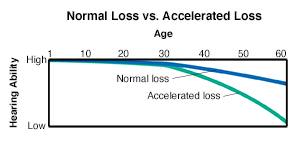
As you age, some hearing loss is normal. Long-term exposure to loud noises may speed up hearing loss. You may lose the ability to hear how loud a sound is. You may also lose the ability to hear certain types of sounds. For instance, you might not be able to hear some of the high-pitched sounds of a child's voice or a fire alarm.
Normal loss
With aging, tiny hair cells in the inner ear change. Nerve cells in the inner ear may also be affected. Most people don't notice normal hearing loss until their middle years. Others might not notice it until late in their lives. It's most often a slow process.
Accelerated loss
Exposure to loud noise may cause hearing loss. It also may cause a ringing in your ears called tinnitus. If your exposure was short, you usually recover your hearing, unless permanent damage was done. But long-term exposure day after day is more likely to affect your hearing for life.
Noise hurts more than your hearing
Did you know that loud noises can affect your whole body? Loud noises can:
Raise blood pressure.
Disrupt sleep patterns.
Cause muscle strain.
Cause emotional stress.
Harm digestion.
Signs of hearing loss
Hearing loss is very common. And it's one of the most common health problems as people age. Most people aged 65 and older have some hearing loss. By age 80, almost everyone does. Hearing loss often occurs slowly over the years. So you may not realize your hearing has gotten worse.
If you have sudden hearing loss, contact your health care provider right away. Your provider will do a medical exam and a hearing exam as soon as possible. Your options for treating the hearing loss may depend on the cause and the type of hearing loss you have.

Have your hearing checked
Contact your health care provider if:
You have to strain to hear normal conversation.
You have to watch other people’s faces very carefully to follow what they’re saying.
You often need to ask people to repeat what they’ve said.
You often misunderstand what people are saying.
You turn the volume of the TV, radio, or computer up so high that others complain.
It sounds like people are mumbling when they’re talking to you.
The effort it takes to hear leaves you feeling tired and irritated.
You hear better with one ear than the other when you use the phone.
Locations

Saint Luke’s Hospital Midwest Ear Institute
Saint Luke’s Ear, Nose, & Throat Specialists–Plaza

Saint Luke’s Ear, Nose, & Throat Specialists–Barry Road

Saint Luke’s Ear, Nose, & Throat Specialists–Overland Park

Saint Luke’s Ear, Nose, & Throat Specialists–Lee's Summit
Relevant News
Article
Passing On the Gift of Hearing
News
Overcoming Hearing Loss, Mighty Melody Continues Writing her Own Song
Article
The Magnificent Maddox: A Saint Luke's Midwest Ear Institute Story
Article