Thyroid Cancer
Thyroid cancer starts in the cells that make up the thyroid gland.
What is cancer?
Cancer starts when cells in the body change (mutate) and grow out of control. To help you understand what happens when you have cancer, let's look at how your body works normally. Your body is made up of tiny building blocks called cells. Normal cells grow when your body needs them, and die when your body doesn't need them any longer.
Cancer is made up of abnormal cells that grow even though your body doesn't need them. In most cancers, the abnormal cells grow to form a lump or mass called a tumor. If cancer cells are in the body long enough, they can grow into (invade) nearby tissues. They can even spread to other parts of the body (metastasize).
What is the thyroid gland?
The thyroid gland is part of the endocrine system. It makes and helps control hormones and the metabolism in your body. It's in the front of your neck, over your windpipe (trachea). It's below your Adam’s apple (thyroid cartilage) and above your collarbone. You often can’t see or feel your thyroid.
It’s shaped like a butterfly with 2 lobes—a right and left lobe. The lobes are joined by a bridge of tissue called the isthmus.
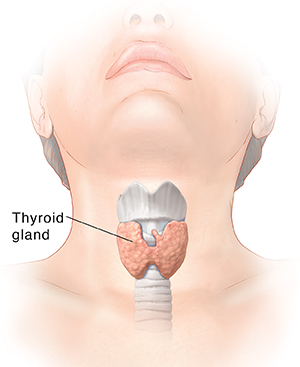
The thyroid is made up of 2 main types of cells:
- Follicular cells. These use iodine to make thyroid hormones. These hormones help control your metabolism.
- C cells or parafollicular cells. These make the hormone calcitonin. This helps control calcium levels.
What is thyroid cancer?
Thyroid cancer starts in the cells that make up the thyroid gland.
There are 5 main types of thyroid cancer (or carcinoma):
- Papillary cancer. This is the most common type. It starts in the follicular cells. It tends to form in only 1 side of the thyroid gland and grow slowly. This type of thyroid cancer may spread to lymph nodes in the neck.
- Follicular cancer. This cancer also forms in the follicular cells of thyroid cancer. It's the next most common type and accounts for about 1 in 10 cases. It's more common in countries where people don't get enough iodine in their diet. This type of thyroid cancer may spread to other areas of the body. It doesn't spread to the lymph nodes very often.
- Hurthle cell cancer. This is a rare form of follicular thyroid cancer. It's harder to find and treat. It tends to not cause symptoms and has often spread to nearby lymph nodes by the time it's found.
- Medullary thyroid cancer (MTC). This is a rare type of thyroid cancer that starts in the C cells. It is also considered a neuroendocrine tumor. It produces a lot of calcitonin and tends to spread very fast.
- Anaplastic cancer. This is also called undifferentiated thyroid cancer. It's very rare. It tends to grow and spread quickly. It's hard to treat.
Most thyroid changes are not cancer
Changes in the thyroid gland are often easy to see and feel. Lumps or bumps, called nodules, are common. Most of them are not cancer (95% to 96% are benign). And they may not need to be treated. Growths that are not cancer don’t spread from the thyroid to other parts of your body.
Thyroid adenomas are small nodules that start in the thyroid gland. They're not cancer. Many times, they're only found while looking at the area around the thyroid for another reason.
Some thyroid adenomas make thyroid hormone. If an adenoma makes too much thyroid hormone, it can cause hyperthyroidism (toxic nodule). This is when there's too much thyroid hormone in your body. It can cause severe tiredness (fatigue), sweating, tremors, and heart palpitations. It may need to be treated.
Some signs that a nodule may be cancer and not an adenoma or other benign nodule include:
- The nodule is not making hormones.
- The nodule is solid instead of filled with fluid, like a cyst.
- The nodule is growing fast.
- Lymph nodes around the thyroid gland are swollen.
How thyroid cancer spreads
When thyroid cancer spreads outside the thyroid gland, it most often goes to nearby lymph nodes first. It can also spread to nearby blood vessels and other tissues in the neck. Over time, it can spread to distant parts of the body, such as the lungs and bones.
Talk with your healthcare provider
If you have questions about thyroid cancer, talk with your healthcare provider. Your healthcare provider can help you understand more about this cancer.
How is thyroid cancer diagnosed?
If your healthcare provider thinks you might have thyroid cancer, you will need certain exams and tests to be sure. Diagnosing thyroid cancer starts with your healthcare provider asking you questions. They will ask you about your health history, your symptoms, risk factors, and family history of disease. Your healthcare provider will also give you a physical exam.
What tests might I need?
You may have one or more of these tests:
Blood tests
Imaging tests
Biopsy
Blood tests
A variety of blood tests will be used to see if your thyroid gland is working the way it should. These tests also help to check your overall health. These blood tests might include:
TSH (thyroid-stimulating hormone). This hormone is made by the pituitary gland in the brain. It tells the thyroid to make hormones called T3 (triiodothyronine) and T4 (thyroxine). This test can tell a lot about the overall activity of your thyroid gland.
Thyroid hormone levels. This test is used to check the level of the thyroid hormones, T3 and T4, in your body.
Calcitonin. Levels of this hormone may be checked if your healthcare provider thinks you may have medullary thyroid cancer (MTC).
CEA (carcinoembryonic antigen). If MTC is suspected, this protein may be checked. MTC causes very high levels of CEA in the blood.
RET-proto-oncogene test. This is another blood test that checks for MTC. This is a gene that is common in MTC and can either be inherited from a parent (germline mutation) or acquired later in life which is called a somatic mutation.
Imaging tests
These tests can be used to look at the size of the thyroid gland. They can also be used to find the size and location of nodules or lumps that might be cancer.
Ultrasound. A thyroid and neck ultrasound is the most common imaging test used. During this painless test, sound waves are used to look for thyroid cancer. The sound waves bounce off your thyroid and send back signals. A computer uses the signals to create an image of your thyroid. The test can help show if a nodule is solid or fluid-filled. The image can show the size and location of any thyroid nodules and nearby swollen lymph nodes. This could mean cancer has spread to them. Ultrasound may be used to help guide a needle into the thyroid nodule or swollen lymph node to do a biopsy.
Radionuclide or radioiodine scan. This test by itself can't diagnose thyroid cancer. A very small, harmless amount of radioactive iodine, called a radiotracer, is swallowed or put in a vein. Over time, it’s absorbed by thyroid cells. This makes the thyroid cells easy to see on the scan that’s done with a special camera several hours later.
CT scan. This test uses X-rays to get detailed cross-sectional images of the body. It can be used to find the location and size of thyroid cancers. It can also be used to help guide a biopsy needle into the area that's thought to be cancer. If MTC is suspected, a CT scan can be used to find other tumors in the body that are often linked with the MTC. You may be given a contrast agent in your vein or to swallow before the CT scan to make the image details more clear. The CT scan might be combined with a PET scan. This uses radioactive sugar to find cancer cells as well.
Biopsy
A biopsy is a test to take small pieces of tissue from the body. The tissue (called a sample) is then looked at under a microscope. A biopsy is the only way to know for sure if a thyroid change is cancer.
During a biopsy, the healthcare provider will use an imaging test, such as an ultrasound, to guide a very thin needle into your thyroid to take out cells and fluid. This is called a fine needle aspiration. This procedure can be done in the healthcare provider's office. The sample is sent to a pathologist, an expert who looks for changes in cells. The pathologist checks the cells and fluid under a microscope for any signs of cancer.
If the fine needle aspiration biopsy results are not clear, it may be repeated. Or a surgical biopsy may be needed. This is when surgery is used to take out the nodule or the affected part of the thyroid gland to check for cancer cells.
Getting your test results
When your healthcare provider has the results of your biopsy, they will contact you with the results. Your provider will talk with you about other tests you may need if thyroid cancer is found. Make sure you ask all of the questions that occur to you so that you can understand the results and what follow-up you need. Consider writing your questions down so you won't forget anything.
Treatment Choices
There are many treatment choices for thyroid cancer. The one that’s best for you depends on things, such as:
The type of thyroid cancer.
The size of the tumor and if it has spread (the stage of the cancer).
Your overall health.
Your personal concerns and preferences.
Learning about your treatment choices
You may have questions and concerns about your treatment choices. You may want to know how you’ll feel, how you'll look, and if you’ll have to change your normal activities.
Your doctor is the best person to answer your questions. They can explain what your treatment choices are, how well treatment is expected to work, what the risks and side effects may be, and what the goals of treatment are.
Your doctor may advise a specific treatment. Or they may offer more than one, and ask you to decide which you'd like to use. It can be hard to make this decision. It's important to take the time you need to make the best decision.
Deciding on the best plan may take some time. Talk with your doctor about how much time you can take to explore your choices. You may want to get a second opinion before deciding on your treatment plan. You may also want to include your partner, spouse, family, or friends in this process.
Goals of treatment for thyroid cancer
Treatment may cure or control the cancer. It can also improve your quality of life by helping to control the symptoms of the disease. The goal of thyroid cancer treatment is to do one or more of these things:
Remove the cancer tumor while doing as little damage as possible to nearby areas.
Kill cancer cells or keep them from growing and spreading.
Keep the cancer from coming back or delay its return.
Ease symptoms of the cancer, such as pain and pressure on nearby tissues.
If the thyroid cancer has spread to other parts of your body, treatments may be focused on helping to control your symptoms. These treatments, called palliative treatments, don’t kill the cancer. They may include pain medicine and treatments for tumor cells that may have spread to bones like radiation. They may also include ways to help you manage problems breathing or swallowing. Palliative treatments are also commonly used along with cancer treatment. For instance, you may get medicine to help prevent nausea when you're getting chemotherapy.
Types of treatment for thyroid cancer
Treatments for thyroid cancer may be local or systemic. You may have both:
Local treatments. These remove, destroy, or control cancer cells in a certain place in the body. For thyroid cancer, the most common local treatment is surgery.
Systemic treatments. These destroy or control cancer cells all over your body. Radioactive iodine therapy and chemotherapy are systemic treatments.
Commonly used treatments for thyroid cancer
These are the main treatments for thyroid cancer:
Surgery. This is the treatment used for most people with thyroid cancer. It's done to take out the tumor along with an edge of healthy tissue around it. The type of surgery done depends on the size of the tumor and the type of thyroid cancer. All or part of the thyroid gland may be removed.
Radioactive iodine (RAI). Your thyroid absorbs iodine. This treatment can find and destroy thyroid cells that were not taken out in surgery or that spread beyond the thyroid. You swallow the RAI. It's a option for many people with papillary, follicular, and Hurthle cell thyroid cancer.
Thyroid hormone medicine. This type of treatment is needed after the thyroid gland has been removed or if it's no longer making enough of the hormones that your body needs. Thyroid hormone medicines replace the hormones your thyroid made. They can also slow down the growth of cancer cells that are still in your body.
External radiation therapy. Strong X-rays or other beams of energy can be used to kill cancer cells. It's used only in certain cases, such as when later stage cancer doesn’t respond to other treatments. Or when later stage cancer has spread to key tissues, such as the voice box or the esophagus (swallowing tube).
Chemotherapy (chemo). This treatment uses strong medicines to kill cancer cells and keep them from growing. It's not often used to treat thyroid cancer, but it may be used if other treatments aren't working.
Targeted therapy. These medicines target specific changes found on some thyroid cancer cells. If your cancer cells have these changes, targeted therapy can be used to kill those cells, while causing little to no damage to healthy cells. These medicines may be used if other treatments aren't working or the cancer comes back after treatment.
You may have just one treatment or a combination of treatments. Most people with thyroid cancer have surgery.
Clinical trials for new treatments
Researchers are always finding new ways to treat cancer. These new methods are tested in clinical trials. Taking part in a clinical trial means you get the best treatment available today, and you might also get new treatments that are thought to be even better. Before starting treatment, talk with your doctor to find out if there are any clinical trials you should think about.
Talking with your doctor
At first, thinking about treatment choices may seem overwhelming. Talk with your doctors, nurses, and loved ones. Make a list of questions. Consider the benefits and possible side effects of each choice. Discuss your concerns with your doctor before making a decision.
What are the symptoms of thyroid cancer?
The most common symptoms of thyroid cancer include:
A lump or swelling over your thyroid or somewhere else in your neck
A cough that lasts, or won't go away, without symptoms of a cold
Hoarseness or other changes in your voice that are persistent
Neck or throat pain, especially in the front of your neck (near your Adam's apple) that can sometimes go up to your ears
Swollen lymph nodes
Swollen neck
Trouble breathing that feels like you are breathing through a straw
Trouble swallowing
When to see your healthcare provider
Many of these symptoms may be caused by other health problems. But it is important to see your healthcare provider if you have these symptoms. Only a healthcare provider can tell if you have cancer.